Prescription Scuba Diving Goggles: Complete 2026 Guide
For divers who require vision correction, the underwater world presents unique challenges that standard eyewear cannot address. The need for scuba diving goggles prescription has grown significantly as more people with myopia, hyperopia, astigmatism, and presbyopia seek to explore the ocean's depths. Unlike regular prescription eyewear, diving equipment must account for water pressure, magnification effects, and the specialized requirements of underwater environments while delivering crystal-clear vision throughout your dive.
Understanding Prescription Options for Diving Masks
The terminology "scuba diving goggles prescription" often causes confusion among new divers. The diving community typically uses the term "diving mask" rather than "goggles" to describe the equipment that covers eyes and nose. This distinction matters because proper diving masks create an air space between your eyes and the water, which is essential for both vision correction and equalization during descents.
Single Vision Distance Correction
Single vision lenses represent the most straightforward solution for divers who need distance correction. These lenses feature one focal point throughout the entire lens surface, optimized for viewing objects at varying distances underwater. The water-air interface creates a magnification effect of approximately 25%, making objects appear closer and larger than they actually are.
Professional divers and recreational enthusiasts typically select single vision distance lenses when:
- Their primary concern involves clearly identifying marine life and underwater features
- Navigation and buddy monitoring require sharp distance vision
- They do not need to read gauges or dive computers close-up
- Their prescription remains stable without significant near-vision requirements
Prescription diving masks with single vision lenses provide excellent clarity for general diving activities while maintaining optical accuracy across the entire viewing field.
Reading and Gauge Vision Solutions
Many divers over 40 experience presbyopia, requiring additional magnification for close-up tasks. Reading segments in diving masks address this need by incorporating magnified zones in the lower portion of the lens. This configuration enables divers to check their gauges, dive computers, and underwater cameras without sacrificing distance vision.
The reading segment placement typically follows these specifications:
| Feature | Specification | Purpose |
|---|---|---|
| Position | Lower 30-40% of lens | Natural downward gaze for gauges |
| Magnification | +1.50 to +3.00 diopters | Close-range clarity |
| Transition | Defined line or blended | Visual preference varies |
| Coverage | Full width or centered | Depends on gauge placement |
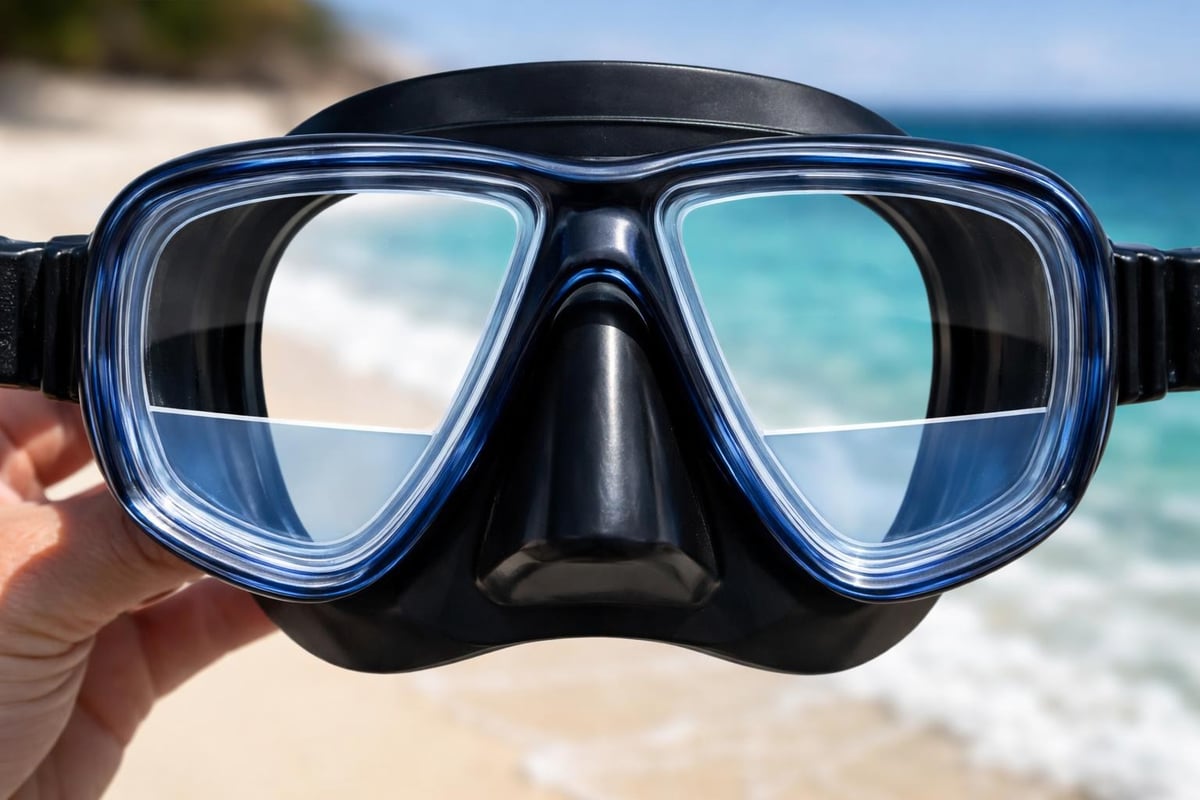
Divers who photograph underwater subjects or operate technical equipment particularly benefit from gauge vision configurations. Prescription reading diving masks have become increasingly popular among the aging diver population seeking to maintain their underwater activities without compromising safety or enjoyment.
Progressive Lens Technology for Diving
Progressive dive masks represent the premium solution for scuba diving goggles prescription needs. These advanced lenses eliminate the visible line found in traditional bifocals while providing seamless transition between distance, intermediate, and near vision zones.
How Progressive Lenses Work Underwater
The progressive design incorporates multiple focal points within a single lens surface. The upper portion handles distance vision for observing marine environments, the middle section addresses intermediate ranges for viewing your buddy or larger equipment, and the lower area provides magnification for reading gauges and computers.
Key advantages of progressive diving masks include:
- Elimination of the "image jump" experienced with lined bifocals
- Wider field of clear vision at all distances
- More natural eye movement patterns
- Enhanced aesthetic appearance without visible lines
- Superior optical quality for demanding dive conditions
However, progressive lenses require an adaptation period. The corridor of clear vision narrows in progressive designs compared to single vision lenses, and peripheral distortion exists in the transition zones. Divers must learn to position their head rather than just their eyes when looking at objects in different zones.
Customization Requirements
Each progressive lens prescription for diving masks demands precise measurements and customization. The optical center positioning, corridor length, and reading zone placement must account for the mask's internal volume and the diver's facial geometry. Progressive diving masks require professional fitting to ensure optimal performance underwater.
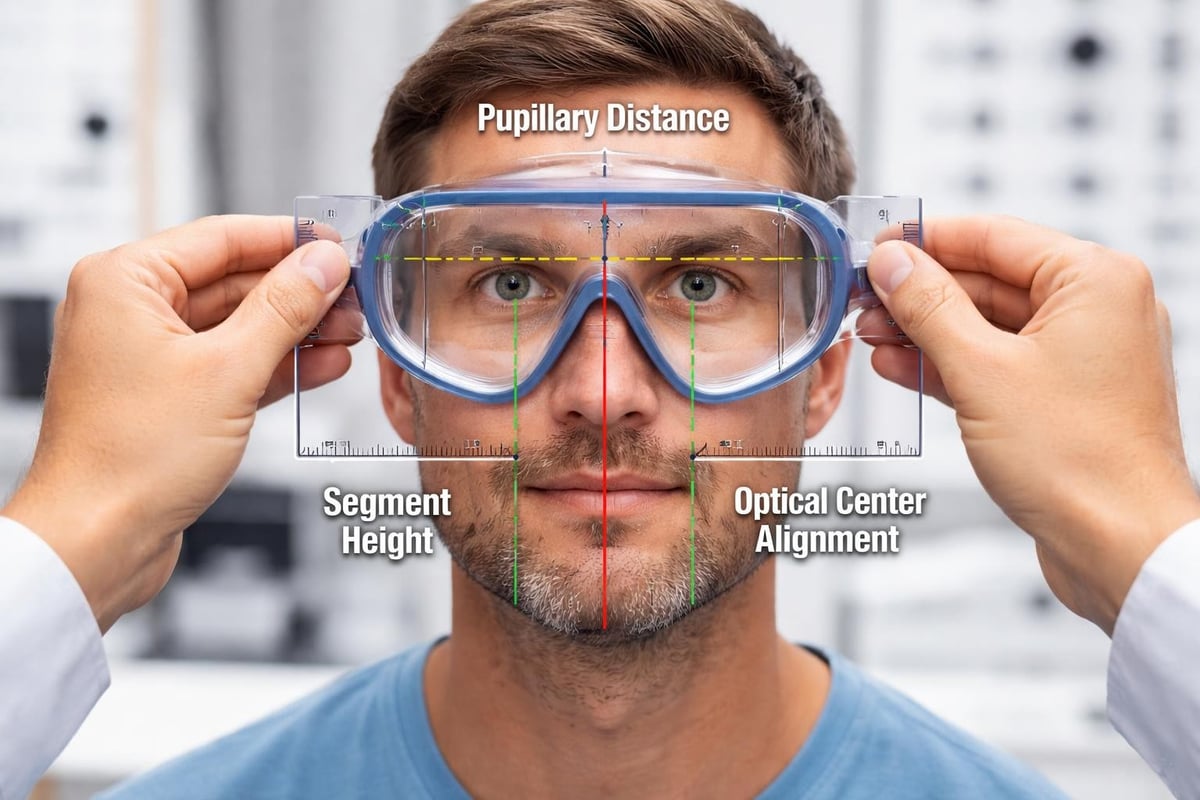
According to experts in prescription dive mask technology, the fitting process includes measuring pupillary distance, segment height, pantoscopic tilt, and vertex distance specific to the chosen mask model.
Lens Materials and Optical Quality
The material composition of scuba diving goggles prescription lenses significantly impacts durability, clarity, and safety during dives. Two primary materials dominate the prescription diving market: optical-grade glass and CR39 plastic.
Glass vs. Plastic Lenses
Glass lenses offer superior scratch resistance and optical clarity, maintaining perfect transparency even after hundreds of dives. The material's density prevents the minor abrasions that accumulate on plastic lenses from sand, salt, and general handling. Glass also provides better color accuracy and contrast underwater, enhancing the visual experience during reef dives and wreck explorations.
Plastic CR39 lenses present advantages in weight reduction and impact resistance. These lenses weigh approximately half as much as equivalent glass lenses, reducing facial fatigue during extended dives. The material also demonstrates greater flexibility, making it less prone to catastrophic failure from impacts.
| Property | Glass Lenses | CR39 Plastic |
|---|---|---|
| Scratch Resistance | Excellent | Good (with coating) |
| Optical Clarity | Superior | Very Good |
| Weight | Heavier | Lighter |
| Impact Resistance | Lower | Higher |
| Lifespan | 10+ years | 5-7 years |
| Cost | Higher | Moderate |
Professional technical divers and underwater photographers frequently choose glass lenses for their superior optical properties, while recreational divers often select CR39 for comfort and safety considerations. SeaVision's prescription dive masks utilize CR39 material for its balance of performance and durability.
Complex Prescription Accommodations
Modern scuba diving goggles prescription technology can accommodate virtually any vision correction requirement, including challenging prescriptions that were previously difficult to incorporate into diving equipment.
Astigmatism Correction
Astigmatism occurs when the cornea has an irregular curvature, causing blurred or distorted vision at all distances. Cylinder correction in prescription diving masks addresses this condition through toric lens surfaces that compensate for the corneal irregularity.
Toric lenses feature different powers in different meridians, requiring precise axis alignment within the mask. The axis measurement (ranging from 1 to 180 degrees) must remain stable during the dive, which necessitates secure lens mounting and proper mask fit. Even slight rotation can significantly degrade visual performance.
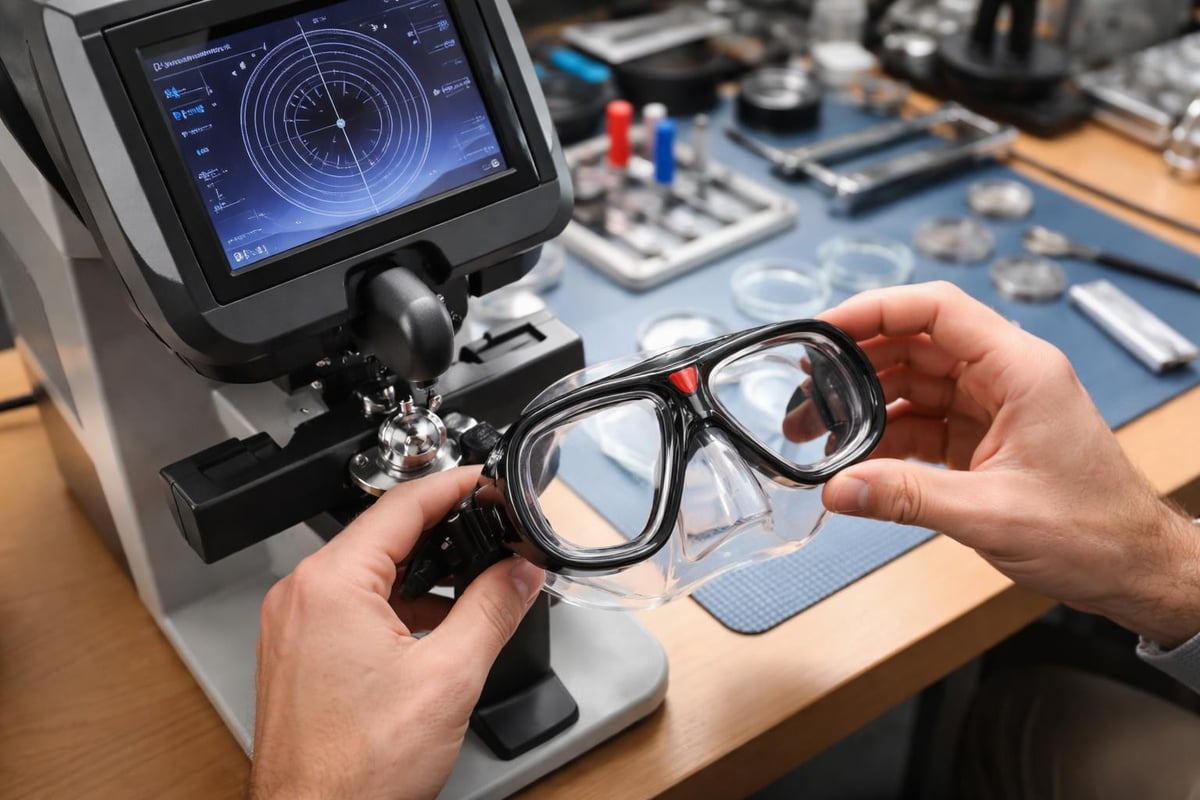
Cylinder powers up to -4.00 diopters are routinely available in custom diving masks, with some manufacturers accommodating even higher corrections. Specialists offering custom prescription dive masks can create lenses for complex astigmatic prescriptions using high-quality Zeiss glass materials.
Prism Corrections and Special Requirements
Divers with binocular vision disorders may require prism correction to align visual axes and prevent double vision underwater. Prism measurements (specified in prism diopters with a base direction) can be incorporated into scuba diving goggles prescription, though they add complexity to the manufacturing process.
Additional special requirements include:
- High myopia corrections beyond -8.00 diopters requiring high-index materials
- Extreme hyperopia necessitating plus lenses with increased center thickness
- Anisometropia where each eye requires substantially different corrections
- Post-surgical accommodations for patients with IOL implants or refractive surgery
These complex prescriptions demand experienced optical technicians and specialized manufacturing capabilities. Custom prescription dive masks from specialized providers ensure that even the most challenging vision requirements receive proper attention.
Prescription Accuracy and Underwater Magnification
The physics of light refraction at the water-air interface creates a magnification effect that impacts prescription calculations for scuba diving goggles prescription. Understanding this phenomenon helps divers select appropriate lens powers for optimal underwater vision.
Refraction and Apparent Distance
When light travels from water into the air space inside your mask, it bends according to Snell's Law. This refraction makes objects appear approximately 33% closer and 25% larger than their actual size and distance. A fish that appears to be 3 feet away actually sits 4 feet from your mask.
This magnification effect has implications for prescription strength. Some divers report that their regular prescription feels slightly different underwater, though modern prescription calculations account for these optical phenomena. The air-water interface magnification remains constant across the mask's viewing area, maintaining consistent vision throughout your field of view.
Prescription Verification and Adjustment
Before committing to scuba diving goggles prescription lenses, verification of your current prescription ensures accuracy. Prescriptions older than two years may no longer reflect your actual vision needs, particularly for divers over 40 experiencing presbyopic changes.
Professional eye examinations should specifically address diving requirements. Inform your optometrist about your underwater activities, as they may recommend slight modifications to optimize your prescription for diving conditions. Some practitioners suggest testing slightly reduced plus power for hyperopic divers or fractionally increased minus power for myopic divers to account for underwater viewing distances.
Mask Selection and Fit Considerations
The foundation of effective scuba diving goggles prescription begins with proper mask selection. Not all mask models accommodate prescription lenses, and the mask's design characteristics significantly impact optical performance and comfort.
Internal Volume and Lens Proximity
Low-volume masks position the lens surface closer to your eyes, reducing the air space that must be cleared during equalization. However, closer lens proximity can create challenges for prescription lens installation, particularly with high-power corrections that require greater center thickness.
Ideal mask characteristics for prescription lenses include:
- Tempered glass lenses (factory standard) that can be replaced with prescription versions
- Adequate internal space to accommodate lens thickness without contact with eyelashes
- Frame design that supports secure lens mounting without distortion
- Comfortable silicone skirt providing reliable seal across facial contours
- Quality buckle systems maintaining strap tension throughout the dive
Professional manufacturers like Atomic and Cressi produce masks specifically designed to accept custom prescription lenses while maintaining hydrodynamic profiles.
Fitting Process and Measurements
Proper fitting requires several critical measurements to ensure your scuba diving goggles prescription delivers optimal vision. Beyond your basic prescription numbers (sphere, cylinder, axis, add power), the optical laboratory needs:
- Pupillary distance (PD): The distance between your pupils, typically 54-74mm for adults
- Segment height: For bifocal or progressive lenses, the vertical placement of reading zones
- Frame dimensions: The specific mask model to ensure compatibility with lens blanks
- Vertex distance: The space between your eyes and the lens surface in the chosen mask
These measurements ensure that the optical centers of your prescription lenses align precisely with your pupils when wearing the mask. Misalignment of even 2-3mm can cause visual discomfort, headaches, and reduced acuity during dives. Detailed guidance on lens types and fitting processes helps divers understand these technical requirements.
Prescription Installation Methods
Two primary methods exist for incorporating prescription correction into diving masks: custom lens replacement and optical inserts. Each approach offers distinct advantages depending on your prescription requirements and budget considerations.
Full Lens Replacement
The premium solution involves removing the mask's factory lenses and replacing them with custom-manufactured prescription lenses. This method provides the best optical quality because the entire viewing surface incorporates your correction without additional air-glass interfaces that can cause distortion or reflections.
Full replacement lenses offer several benefits:
- Unobstructed field of view across the entire mask surface
- Single optical surface minimizing light scatter and reflection
- Permanent installation that doesn't shift or require adjustment
- Professional appearance indistinguishable from standard masks
- Optimal strength-to-weight ratio for the specific prescription
Manufacturing full replacement lenses requires specialized equipment and expertise. The process typically takes 2-4 weeks as optical laboratories create custom lenses matching your prescription and mask specifications, then professionally install them using specialized bonding techniques guaranteed for durability.
Optical Insert Systems
Optical inserts consist of smaller prescription lenses mounted in frames that attach to the inside of your standard mask lenses. This approach offers flexibility and cost advantages, particularly for divers who want to use the same mask with different prescriptions or share equipment.
Insert systems work well for:
- Temporary prescription solutions while awaiting custom lenses
- Rental or shared diving equipment scenarios
- Divers with frequently changing prescriptions
- Budget-conscious individuals seeking lower-cost options
- Backup mask configurations for travel
However, inserts create two air-glass interfaces instead of one, potentially introducing reflections, slight distortions, and cleaning challenges. The insert frames also obstruct portions of your peripheral vision. Professional resources on prescription dive masks discuss the effectiveness and trade-offs between these installation methods.
Maintenance and Longevity
Proper care extends the lifespan of scuba diving goggles prescription while maintaining optimal optical clarity. Prescription lenses demand more attention than standard mask maintenance due to their specialized coatings and precise optical surfaces.
Cleaning and Storage Protocols
Salt water, minerals, and biological materials in ocean environments create deposits on lens surfaces that reduce clarity and can damage coatings over time. Immediate post-dive rinsing with fresh water removes these contaminants before they bond to the glass or plastic surface.
Daily maintenance should include:
- Thorough freshwater rinse immediately after each dive
- Gentle cleaning with mild dish soap using fingertips only
- Complete air drying before storage in a protective case
- Storage away from direct sunlight and heat sources
- Periodic inspection for scratches, delamination, or coating damage
Avoid using abrasive cloths, paper towels, or commercial glass cleaners containing ammonia on prescription lenses. These materials and chemicals can damage anti-reflective coatings and scratch optical surfaces. Microfiber cloths designed for eyeglasses provide safe cleaning for prescription dive masks.
Preventing Fog and Maintaining Clarity
Fogging occurs when temperature differences cause condensation on the lens interior. Prescription scuba diving goggles prescription face the same fogging challenges as standard masks, requiring proper treatment for clear vision throughout your dive.
Pre-dive preparation typically involves:
- Apply commercial defog solution or diluted baby shampoo to dry lens surfaces
- Spread the solution thoroughly across all optical surfaces
- Allow brief contact time (30-60 seconds)
- Rinse lightly with water (freshwater or seawater depending on product instructions)
- Avoid touching the treated surfaces before the dive
Some divers advocate for the "burn method" where lighter flame briefly passes over new lenses to remove manufacturing residue. However, this technique risks damaging prescription lenses and their specialized coatings. Commercial defog products provide safer, more reliable results for prescription diving equipment.
Cost Considerations and Value Analysis
Investment in scuba diving goggles prescription represents a significant expense beyond standard diving equipment. Understanding the cost structure helps divers make informed decisions about their vision correction options.
Price Range and Factors
Prescription diving masks typically range from $200 to $800 depending on several variables:
| Cost Factor | Budget Range | Premium Range |
|---|---|---|
| Base Mask | $40-$80 | $100-$200 |
| Lens Material | CR39 standard | High-index glass |
| Prescription Complexity | Simple sphere | Complex with astigmatism |
| Lens Type | Single vision | Progressive multifocal |
| Coatings | Basic AR coating | Premium multi-layer |
| Manufacturing | Standard turnaround | Rush processing |
Complex prescriptions requiring high-index materials, astigmatism correction, or progressive designs increase costs substantially. However, the investment typically provides 5-10 years of service with proper maintenance, averaging $20-$80 annually for clear underwater vision.
Return on Investment
Comparing prescription masks to alternative vision correction methods highlights the value proposition. Contact lenses present ongoing costs, discomfort risks, and potential loss during diving. Standard masks with optical inserts offer lower initial investment but reduced optical quality and durability concerns.
The comprehensive value includes:
- Safety enhancement through reliable, stable vision correction
- Enjoyment maximization by experiencing underwater environments clearly
- Equipment longevity with professional-grade construction and materials
- Convenience factor eliminating contact lens concerns and complications
- Professional appearance for dive instructors and guides
Professional divers, underwater photographers, and serious recreational enthusiasts consistently report that prescription masks deliver exceptional value despite higher upfront costs. The ability to see clearly without compromising safety or comfort justifies the investment for most vision-impaired divers.
Selecting the Right Provider
Choosing a qualified provider for your scuba diving goggles prescription ensures proper measurements, quality materials, and reliable service. The specialized nature of prescription diving equipment demands expertise beyond standard optical services.
Evaluation Criteria
Reputable prescription dive mask providers demonstrate several key characteristics. They maintain comprehensive knowledge of diving equipment alongside optical expertise, understanding how mask design interacts with prescription requirements. Technical capability extends to accommodating complex prescriptions including high myopia, astigmatism, and progressive corrections.
Essential provider qualifications include:
- Experience with multiple mask brands and models
- Access to high-quality lens materials from reputable manufacturers
- Professional measurement protocols and fitting services
- Transparent pricing with detailed breakdowns of costs
- Warranty coverage on both manufacturing and installation
- Responsive customer service for adjustments and concerns
Specialized providers of prescription eyewear for diving often offer features like near-vision correction optimization and compatibility with full-face dive helmets. Expert fitting services typically include consultation on lens options and detailed process explanations.
Turnaround Time and Service
Custom prescription lens manufacturing requires patience. Standard processing times range from 2-4 weeks from order placement to delivery, though rush services may reduce this to 7-10 days with additional fees. International orders may experience extended timeframes due to shipping and customs processing.
Planning ahead ensures your scuba diving goggles prescription arrives before scheduled dive trips or certification courses. Many divers order 6-8 weeks before major diving vacations, allowing time for fitting verification and potential adjustments if needed.
Special Applications and Advanced Uses
Beyond recreational diving, prescription masks serve specialized applications requiring specific optical configurations and performance characteristics.
Technical and Commercial Diving
Technical divers conducting deep, decompression, or overhead environment diving face extended underwater exposure demanding reliable vision correction. These applications often require:
- Enhanced durability for extreme pressure conditions
- Compatibility with full-face masks and communication systems
- Integration with helmet-mounted lighting and camera systems
- Redundancy planning with backup prescription masks
Commercial divers working on underwater construction, inspection, or salvage operations need prescription solutions compatible with surface-supplied air systems and commercial diving helmets. Specialized optical inserts designed for Kirby Morgan and other commercial helmets accommodate prescription requirements while maintaining helmet integrity and safety certifications.
Underwater Photography and Videography
Professional and amateur underwater photographers require exceptional visual acuity for composition, focus verification, and subject tracking. Scuba diving goggles prescription for photography often incorporate:
- Enhanced color accuracy through premium glass materials
- Wide field of view for peripheral awareness while framing shots
- Progressive or bifocal designs for viewing camera controls and displays
- Anti-reflective coatings reducing glare from strobes and video lights
Photographers working in macro environments particularly benefit from reading zones optimized for the specific working distance of their camera systems. Comprehensive FAQ resources address common questions about prescription options for specialized diving applications.
Freediving and Apnea
Freedivers and competitive apnea athletes require low-volume masks minimizing air space for easier equalization during rapid descents. Prescription options for apnea masks face additional constraints due to the reduced available space for lens thickness.
Single vision distance correction works best for freediving applications. The sport's emphasis on streamlining and minimal equipment makes complex prescriptions with reading segments or progressive designs less practical. High-index materials allow stronger prescriptions to fit within low-volume mask profiles.
Alternative Solutions and Comparisons
While dedicated scuba diving goggles prescription represent the optimal solution for many divers, alternative approaches exist for specific situations and preferences.
Contact Lenses for Diving
Soft contact lenses can be worn during diving, though this approach presents several challenges. The enclosed air space in a diving mask prevents contacts from washing out during normal diving, but mask flooding or removal underwater creates risk of lens loss.
Concerns with contact lens diving include:
- Infection risk from waterborne pathogens trapped against the eye
- Lens dehydration from extended exposure to dry mask environments
- Difficulty with lens replacement if lost during the dive
- Discomfort from salt water or pool chemical contamination
- Vision disruption if lenses shift or fold during pressure changes
Divers who choose contact lenses typically use daily disposables, accepting potential loss, and carry backup prescription masks for emergencies. However, the inconvenience and risks make dedicated prescription masks the preferred choice for regular diving activities.
Stick-On and Temporary Solutions
Adhesive bifocal lenses that attach to standard mask lenses offer inexpensive temporary solutions for presbyopic divers needing reading capability. These stick-on magnifiers typically range from +1.50 to +3.00 diopters and cost $15-$30 per set.
Limitations of temporary solutions include:
- No distance vision correction capability
- Limited durability with repeated water exposure
- Potential for adhesive failure and lens loss
- Optical quality inferior to custom lenses
- Restricted placement options affecting gauge viewing angles
These products serve best as emergency backups or trial solutions while divers evaluate whether bifocal or progressive prescriptions meet their needs before investing in custom scuba diving goggles prescription.
Pediatric and Junior Diver Considerations
Young divers present unique challenges for prescription diving equipment due to rapidly changing prescriptions and different sizing requirements.
Growing Prescription Needs
Children and teenagers typically experience prescription changes every 12-24 months as their eyes develop. This creates a cost-benefit analysis challenge: investing in custom prescription masks that may become obsolete within a year or two versus using contact lenses or temporary solutions.
Kids diving equipment collections include smaller mask models suitable for younger faces. Options for pediatric prescription diving include:
- Conservative prescription approach using slightly outdated prescriptions that remain functional
- Optical insert systems allowing prescription updates without replacing entire masks
- Budget-friendly CR39 lenses accepting shorter lifespan due to prescription changes
- Contact lens use for older teenagers comfortable with lens handling
Parents should consult pediatric optometrists about prescription stability before investing in permanent prescription lens installation. Many eye care professionals can predict prescription trajectory based on growth patterns and historical changes.
Safety and Certification Requirements
Youth diving certifications typically begin at age 10-12 depending on the training agency. Clear vision contributes significantly to safety for junior divers learning fundamental skills and building confidence underwater. Prescription diving masks for young divers help ensure they can clearly see instructors, read hand signals, and navigate safely.
Consideration should be given to mask sharing among siblings with similar prescriptions or opting for modular systems that allow lens updates as children grow. Some families maintain both prescription and non-prescription versions of the same mask model, using the corrective version for actual diving and standard masks for pool practice.
Achieving clear underwater vision through scuba diving goggles prescription transforms the diving experience from blurry uncertainty to crisp clarity, enabling divers with vision correction needs to fully appreciate marine environments. The combination of advanced lens materials, precise optical manufacturing, and professional fitting creates custom solutions accommodating virtually any prescription requirement. Whether you need simple distance correction, progressive multifocal designs, or complex astigmatism accommodation, specialized prescription diving masks deliver reliable performance across hundreds of dives. diving-mask.com offers comprehensive prescription diving solutions with customized lenses manufactured to exacting standards, progressive options for age-related vision changes, and expert guidance throughout the selection and fitting process.